
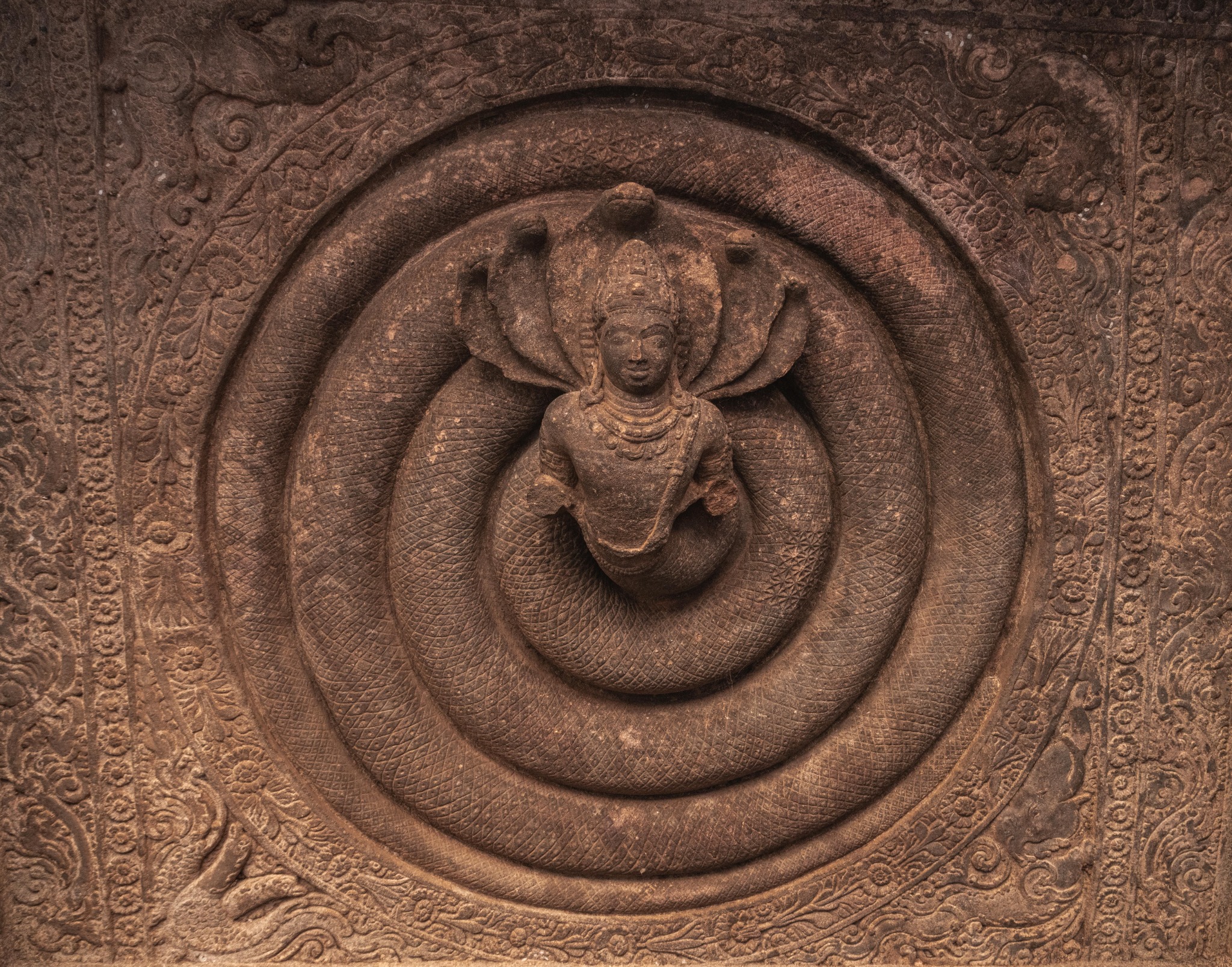
“Rahu sounds frightening.” “Ketu sounds like giving everything up.” Neither shortcut does justice to how these two grahas function in traditional Jyotish.
What are Rahu and Ketu, exactly?
The Moon’s orbit is tilted relative to the plane of Earth’s orbit around the Sun. Where those two planes intersect are the lunar nodes. The ascending node is called Rahu in Jyotish, and the descending node is Ketu. They face each other across the zodiac, roughly 180 degrees apart.
Because eclipses can occur when the Sun and Moon line up near these nodes, Indian mythological traditions developed vivid stories about Rahu and Ketu. They are often called chhaya grahas, or shadow grahas.
Rahu: the pull of what is unfamiliar
Traditional interpretations connect Rahu with hunger, ambition, novelty, foreignness, unusual routes and restlessness. A person might use that imagery to reflect on why a goal feels compelling even after they have achieved something similar before.
Rahu is not simply a promise of foreign travel, fame or technology work. Those claims require additional chart factors and still remain interpretations.
Ketu: the freedom to step back
Ketu is often associated with detachment, introspection, subtraction, spirituality and the wish to move beyond an old fixation. That need not mean giving up relationships or responsibilities. Sometimes the constructive question is whether a habit or ambition is still serving you.
Why read them as an axis?
Since the nodes are opposite one another, a chart places them across two areas of life. Their contrast can be read symbolically as pursuit and release: what pulls us outward and what encourages us to look inward.
Neither node is automatically “good” or “bad.” A tradition that emphasizes a planet’s house, sign, ruler, connections and timing cannot meaningfully reduce the nodes to two universal slogans.
The nodes are real astronomical points. Their proposed influence on life events is a traditional astrological interpretation, not an established scientific effect.
Explore the wider context in the nine-graha guide and the twelve houses.
Further reading: Traditional classification of the nodes within navagraha — reference. These sources describe the tradition, not proof of personal outcomes.
 Built by hand
 Read together, not averaged
 From your actual chart